

How to Learn Vocabulary Effectively: The Ultimate Guide for Students and English Learners (2026)

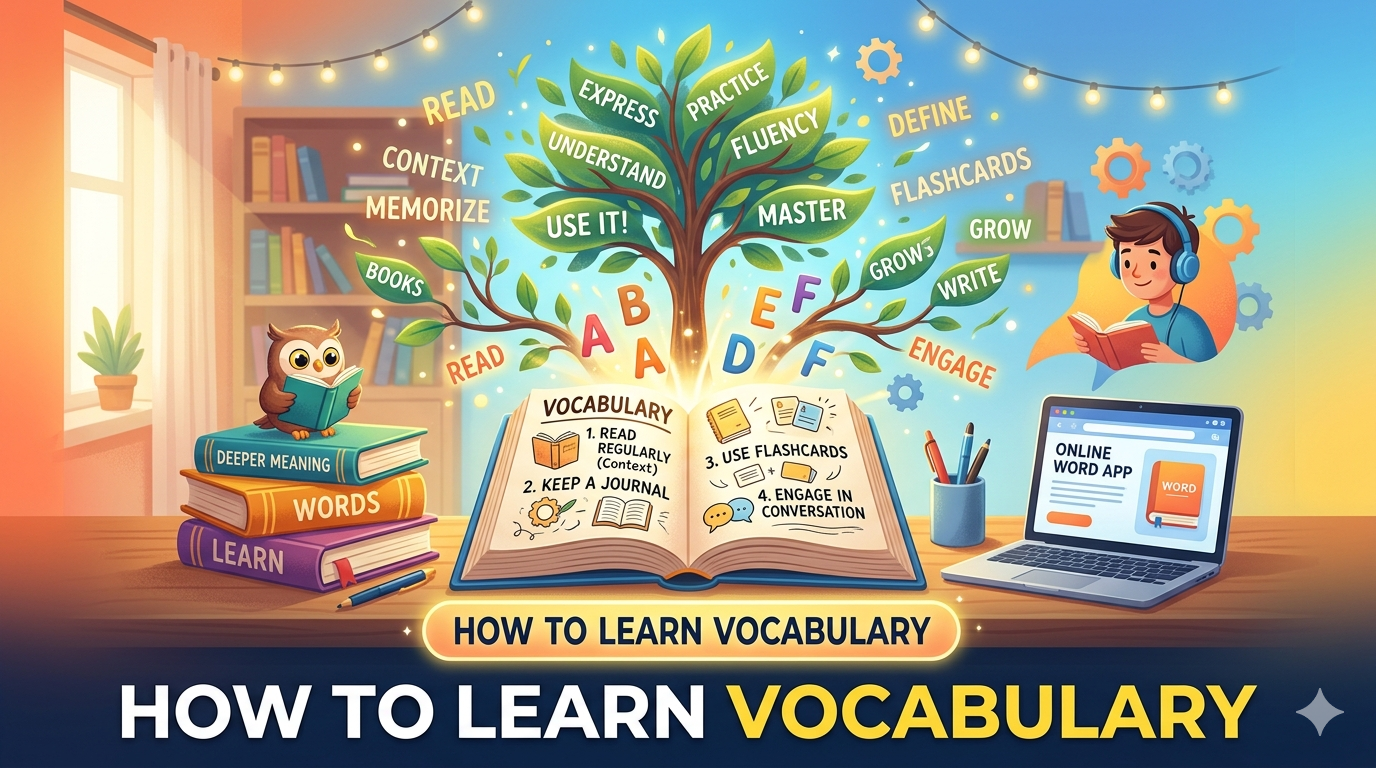
How to Learn Vocabulary Effectively: The Ultimate Guide for Students and English Learners (2026)
Vocabulary plays a major role in every aspect of communication. Whether you want to speak fluent English, crack competitive exams, improve writing skills, or boost your confidence during interviews, a strong vocabulary can completely change your personality and performance.
Many students struggle with English because they know grammar rules but lack the right words to express themselves. Some students try to memorize hundreds of words from dictionaries, but they forget them within a few days. This happens because vocabulary cannot be mastered through memorization alone. It requires understanding, practice, repetition, and real-life usage.
The good news is that anyone can improve vocabulary with the right strategy and daily practice. You do not need to be naturally talented in English. Even learning a few new words every day can create massive improvement over time.
In this article, you will learn the best techniques, habits, and practical methods to improve vocabulary quickly and effectively.
What is Vocabulary?
Vocabulary refers to the collection of words a person knows and uses while speaking, reading, listening, and writing.
Vocabulary is mainly divided into two types:
Active Vocabulary
These are the words you use regularly while speaking and writing.
Passive Vocabulary
These are the words you understand while reading or listening but rarely use yourself.
The main goal of vocabulary learning should be converting passive vocabulary into active vocabulary.
Why Vocabulary is Important
A strong vocabulary improves communication and helps you express ideas clearly. It also increases confidence and improves understanding.
Benefits of Good Vocabulary
1. Improves English Speaking Skills
When you know more words, you can speak more confidently and naturally.
2. Helps in Competitive Exams
Vocabulary questions are common in exams like:
- SSC
- Bank Exams
- UPSC
- CAT
- NDA
- CDS
- IELTS
- TOEFL
A strong vocabulary helps in reading comprehension, cloze tests, sentence improvement, and error detection.
3. Improves Writing Skills
Good vocabulary makes your writing attractive, professional, and impactful.
4. Boosts Confidence
People with strong vocabulary usually communicate with more confidence during interviews and presentations.
5. Enhances Reading Ability
Understanding difficult articles, newspapers, and books becomes easier.
Best Ways to Learn Vocabulary Effectively
There is no magic shortcut for vocabulary improvement. However, smart learning methods can make the process faster and easier.
1. Read Every Day
Reading is one of the most powerful ways to improve vocabulary naturally.
When you read regularly, you encounter new words in different contexts. This helps your brain understand how words are actually used.
What You Can Read
- Newspapers
- Novels
- Educational blogs
- Magazines
- Story books
- English websites
- Editorial articles
Best Newspapers for Vocabulary
- The Hindu
- Indian Express
- Times of India
While reading:
- Underline difficult words
- Search their meanings
- Write them in a notebook
- Use them in sentences
This simple habit can improve vocabulary dramatically.
2. Learn Words Through Sentences
One of the biggest mistakes students make is memorizing only meanings.
If you only learn:
“Abandon = Leave”
You may forget it quickly.
Instead, learn the word with examples.
Example:
Word: Abandon
Meaning: To leave completely
Sentence:
The sailors had to abandon the ship during the storm.
Learning through context improves memory and understanding.
3. Maintain a Vocabulary Notebook
A vocabulary notebook is extremely useful for revision and practice.
Your notebook should include:
- Word
- Meaning
- Synonyms
- Antonyms
- Sentence
- Pronunciation
Example Format
| Word | Meaning | Synonym | Antonym |
|---|---|---|---|
| Brave | Courageous | Bold | Cowardly |
Daily revision of this notebook can improve retention.
4. Learn Root Words, Prefixes, and Suffixes
Understanding word roots helps you guess meanings of unfamiliar words.
Example Prefixes
“Un” = Not
- Unhappy
- Unfair
- Unusual
“Pre” = Before
- Preview
- Predict
- Prehistoric
Example Suffixes
“-ful” = Full of
- Helpful
- Beautiful
- Powerful
This technique allows you to understand thousands of words more easily.
5. Use Flashcards
Flashcards are excellent for quick revision.
You can:
- Write the word on one side
- Write meaning and sentence on the other side
You can use:
- Paper flashcards
- Mobile apps like Quizlet or Anki
Flashcards help in long-term memory retention.
6. Watch English Movies and Videos
Learning vocabulary through entertainment is both effective and enjoyable.
You can watch:
- English movies
- Web series
- YouTube channels
- Podcasts
- Interviews
- TED Talks
Benefits
- Improves pronunciation
- Improves listening skills
- Helps understand natural expressions
- Teaches practical vocabulary
Try watching with subtitles initially.
7. Practice Speaking Daily
Speaking is one of the fastest ways to remember vocabulary.
Even if your English is weak, start speaking small sentences daily.
Tips
- Use new words during conversation
- Talk in front of a mirror
- Record your voice
- Practice with friends
The more you use words, the stronger your vocabulary becomes.
8. Write Daily
Writing helps your brain organize vocabulary properly.
You can write:
- Short paragraphs
- Diary entries
- Essays
- Social media captions
- Stories
Try to include newly learned words in your writing.
9. Learn Synonyms and Antonyms
This method increases word knowledge quickly.
Example
Beautiful
- Synonyms: Attractive, Pretty, Gorgeous
- Antonyms: Ugly, Unattractive
Learning related words improves understanding deeply.
10. Revise Regularly
Revision is the secret weapon of vocabulary mastery.
Without revision, you may forget most words.
Smart Revision Method
- Revise after 1 day
- Revise after 1 week
- Revise after 1 month
This strengthens long-term memory.
Common Mistakes While Learning Vocabulary
1. Learning Too Many Words Daily
Quality matters more than quantity.
Learning 5 words properly is better than memorizing 50 words poorly.
2. Ignoring Pronunciation
Correct pronunciation is important for speaking confidence.
Use dictionaries with audio pronunciation.
3. Never Using the Words
Words become permanent only when used actively.
4. Depending Only on Rote Learning
Understanding meaning and context is more important than memorization.
Best Vocabulary Apps and Resources
Apps
- Quizlet
- Anki
- Duolingo
- Memrise
Websites
- Vocabulary.com
- Merriam-Webster
- Cambridge Dictionary
YouTube Channels
- BBC Learning English
- Speak English With Vanessa
- English Adda
Daily Vocabulary Improvement Routine
Here is a simple routine for students:
| Time | Activity |
|---|---|
| 15 Minutes | Read English article |
| 10 Minutes | Learn 5 new words |
| 10 Minutes | Make sentences |
| 10 Minutes | Revise old vocabulary |
| 15 Minutes | Speak or listen in English |
Following this routine daily can create huge improvement within 3–6 months.
Vocabulary Learning Tips for Competitive Exams
If you are preparing for SSC, Banking, UPSC, or other exams, focus on:
- Editorial vocabulary
- One-word substitutions
- Idioms and phrases
- Synonyms and antonyms
- Cloze test vocabulary
Important Tip
Learn words from previous year papers because many words repeat in exams.
How Long Does It Take to Improve Vocabulary?
Vocabulary improvement is a gradual process.
If you learn:
- 5 words daily = 150 words monthly
- 10 words daily = 3650 words yearly
Consistency creates powerful results over time.
Final Thoughts
Vocabulary improvement is not difficult if you follow the right approach. The key is consistency, smart learning, and regular usage.
Do not try to become perfect overnight. Small daily progress creates massive long-term success.
Remember these golden rules:
- Read daily
- Learn words in context
- Revise regularly
- Speak confidently
- Practice writing
The more words you learn, the more powerful your communication becomes.
Start your vocabulary journey today and transform your English skills step by step.
FAQs About Vocabulary Learning
How many words should I learn daily?
Learning 5–10 words daily is enough if you revise properly.
What is the fastest way to improve vocabulary?
Reading regularly and using words in speaking is one of the fastest methods.
Can vocabulary improve spoken English?
Yes. Vocabulary is essential for fluent and confident communication.
Which is better: reading or memorizing?
Reading with understanding is far more effective than simple memorization.
How can beginners improve vocabulary?
Beginners should start with simple words, daily reading, and sentence practice.
SEO Keywords
how to learn vocabulary, vocabulary improvement tips, english vocabulary learning methods, improve vocabulary fast, vocabulary building techniques, english speaking vocabulary, vocabulary for competitive exams, best vocabulary tips, vocabulary practice daily, english learning guide, vocabulary learning tricks, improve spoken english vocabulary, vocabulary words for students, english word power, daily vocabulary practice
